
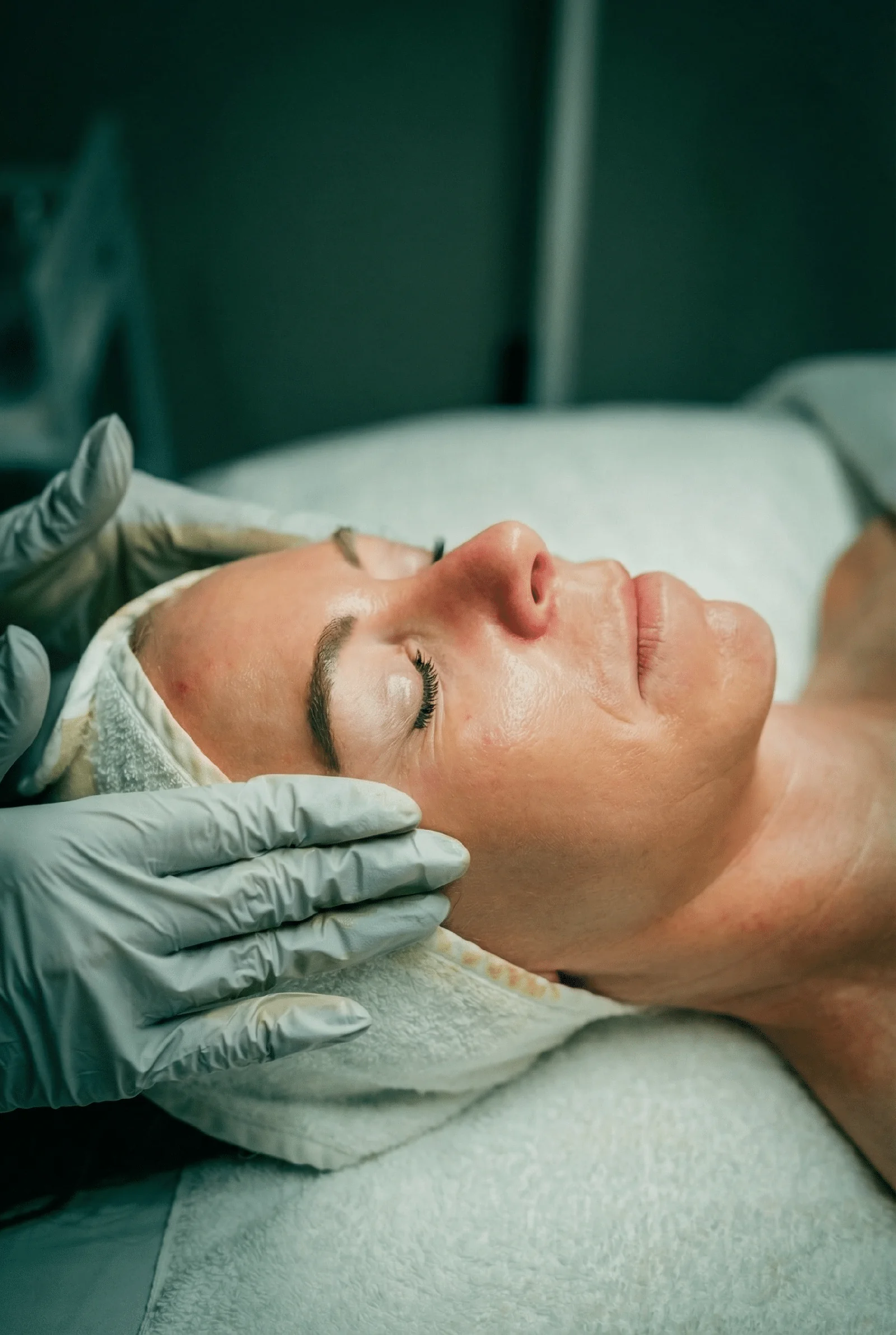
If you have been researching hair restoration or advanced skin regeneration in Austin, you have almost certainly encountered three terms that get used interchangeably — and incorrectly: PDRN, PRP, and exosomes. They are not the same thing. They work through different mechanisms, carry different evidence bases, and produce meaningfully different results depending on what you are trying to treat.
This guide breaks down exactly what each therapy does, where the clinical evidence stands, and how we use them at Banyan & Bamboo in South Austin.
What Is PRP (Platelet-Rich Plasma)?
PRP is the original regenerative therapy in aesthetics. The process involves drawing a small amount of your blood, spinning it in a centrifuge to concentrate the platelets, and injecting that platelet-rich plasma into the scalp or skin. Platelets release growth factors — including PDGF, TGF-beta, and VEGF — that stimulate cellular repair, collagen production, and follicle activity.
What the evidence shows: PRP for hair loss has a solid body of clinical literature behind it. A 2019 meta-analysis published in Dermatologic Surgery found statistically significant improvements in hair density and thickness across multiple randomized controlled trials. For skin, PRP has been used in combination with microneedling for over a decade with consistent results for acne scars and skin texture.
The limitations: PRP is autologous — it comes from your own blood — which means results vary based on your platelet concentration and overall health. The centrifuge process and platelet concentration protocol also vary significantly between providers, which explains the inconsistency in outcomes across clinics. PRP requires a blood draw at every session, and results typically require 3–6 treatments to become visible.
What Is PDRN (Polydeoxyribonucleotide)?
PDRN is a pharmaceutical-grade extract derived from salmon DNA. It is not a blood product — it is a purified, standardized compound that has been used in wound healing and tissue regeneration in Europe and Asia for over 20 years before entering the aesthetics market.
PDRN works by activating adenosine A2A receptors, which triggers a cascade of cellular repair processes: it upregulates growth factors, reduces inflammatory cytokines, and directly stimulates fibroblast proliferation. In plain terms: it tells your cells to repair and regenerate at an accelerated rate.
What the evidence shows: PDRN has a strong clinical track record in wound healing and is increasingly well-studied in aesthetics. A 2022 study in the Journal of Cosmetic Dermatology found PDRN significantly improved skin hydration, elasticity, and wrinkle depth compared to placebo. For hair restoration, PDRN activates follicle stem cells and has shown results comparable to PRP in head-to-head studies — with the advantage of a standardized, consistent formulation.
Why we use PDRN at Banyan & Bamboo: The standardization is the key advantage. Unlike PRP, PDRN delivers a consistent, pharmaceutical-grade dose every session. No blood draw required. Results are more predictable. It is also better tolerated by clients who are sensitive to injections or who want a less invasive protocol.
At Banyan & Bamboo, PDRN is the active ingredient in our Mermaid Facial — applied topically with microneedling channels to drive deep infusion — and in our scalp restoration protocol for the Head Spa.
What Are Exosomes?
Exosomes are the newest entry in regenerative aesthetics, and the most misunderstood. They are extracellular vesicles — tiny membrane-bound packets released by cells — that carry growth factors, proteins, and genetic material (including mRNA and microRNA) between cells. They are essentially the communication signals that tell cells what to do.
In aesthetic medicine, exosomes are typically derived from stem cells (most commonly mesenchymal stem cells from umbilical cord tissue or adipose tissue) and are applied topically or injected to deliver a concentrated payload of regenerative signals.
What the evidence shows: Exosome research is promising but early-stage compared to PRP and PDRN. The mechanism is compelling — exosomes carry significantly more growth factors than PRP — but large-scale, long-term clinical trials in aesthetics are still limited. The FDA has also issued warnings about some exosome products that are being marketed without proper regulatory clearance. Quality and sourcing vary enormously between manufacturers.
Where exosomes make sense: For clients who have already done PRP or PDRN series and want to push results further, or for post-procedure recovery where accelerated healing is the goal, exosomes are a legitimate upgrade. The key is sourcing — only pharmaceutical-grade, properly regulated products should be used.
Side-by-Side Comparison
| PRP | PDRN | Exosomes | |
|---|---|---|---|
| Source | Your own blood | Salmon DNA extract | Stem cell-derived vesicles |
| Mechanism | Growth factor release from platelets | A2A receptor activation, fibroblast stimulation | Multi-pathway cellular signaling |
| Evidence Level | Strong (20+ years in aesthetics) | Strong (20+ years in wound healing, growing in aesthetics) | Promising, early-stage in aesthetics |
| Consistency | Variable (depends on your blood) | Standardized pharmaceutical dose | Varies by manufacturer |
| Blood Draw Required | Yes | No | No |
| Best For | Hair restoration, skin texture, acne scars | Hair restoration, skin regeneration, post-procedure recovery | Advanced regeneration, post-procedure acceleration |
| Sessions Needed | 3–6 | 3–4 | 1–3 (often combined) |
| Price Range | $400–$800/session | $300–$600/session | $600–$1,200/session |
Which One Is Right for You?
Choose PDRN if: You want a standardized, evidence-backed regenerative protocol without a blood draw. Ideal for hair thinning, scalp health, post-microneedling recovery, and skin regeneration. This is our first recommendation for most clients at Banyan & Bamboo because of its consistency and tolerability.
Choose PRP if: You prefer an autologous (your own biology) approach, or if you have had strong results with PRP previously. PRP remains a gold standard for hair restoration and works well in combination with microneedling.
Choose Exosomes if: You are an advanced client who has already completed a PRP or PDRN series and wants to maximize results, or if you are recovering from a more aggressive procedure and want accelerated healing.
Combine them if: You are serious about hair restoration or skin regeneration. PDRN + microneedling is our most popular combination for scalp health. PRP + microneedling remains a proven protocol for acne scar revision.
What We Offer at Banyan & Bamboo
Our PDRN protocols are available as:
- The Mermaid Facial — PDRN infused via microneedling channels for deep skin regeneration. Addresses acne scars, hyperpigmentation, and skin texture.
- Head Spa PDRN Upgrade — PDRN growth serum applied to the scalp during the Hydration Scalp Waterfall Therapy session. Stimulates follicles, improves scalp circulation, and supports hair density.
- The Mermaid Lift — Our most advanced protocol: microneedling + PDRN infusion for clients targeting significant skin concerns or wanting the fastest visible regeneration results.
We do not currently offer PRP or exosomes as standalone services. If you are comparing providers and want to understand which protocol is right for your specific concerns, book a complimentary AI 3D Skin Analysis — we will map your skin's current state and give you a clear recommendation.
Frequently Asked Questions
Is PDRN safe for all skin tones? Yes. PDRN is one of the safest regenerative options for darker skin tones because it does not carry the post-inflammatory hyperpigmentation risk that some laser treatments do. It works through cellular signaling rather than thermal energy.
How many PDRN sessions do I need for hair restoration? Most clients see meaningful improvement after 3–4 sessions spaced 3–4 weeks apart. Maintenance sessions every 3–6 months are recommended for ongoing results.
Can I combine PDRN with Botox or fillers? Yes, but timing matters. We typically recommend spacing PDRN treatments at least 2 weeks from injectable appointments to avoid any interference with the healing response.
Is PDRN the same as salmon sperm DNA? PDRN is derived from salmon DNA, but it is a purified, pharmaceutical-grade extract — not raw biological material. The purification process removes proteins and other components, leaving only the polydeoxyribonucleotide chains that activate the A2A receptor pathway.
How does PDRN compare to hyaluronic acid skin boosters (like Profhilo or Juvederm Volite)? They work differently. Hyaluronic acid boosters primarily improve hydration and skin quality through water-binding. PDRN stimulates cellular repair and collagen production at a deeper level. They are complementary, not competing — some clients benefit from both.